Ági Kovács became an Olympic champion in 2000 at the age of 19 with a fearsome speed, and 2014 was the year of great recognition. At the age of 33, she was chosen as an immortal of swimming in America and became an honorary citizen of Budapest. This year, she is making great strides towards her doctoral degree. Even after starting a family, her life was filled with learning.
She is writing her doctoral dissertation entitled The Relationship between Elite Athletes and the Media in 21st Century Hungary. Many people vividly remember the image of radio reporter Dániel Molnár chasing her in Seville with a microphone in his hand after her victory at the European Championships in 1997. Are you referring to this too?
Oh, this is a very cute story, and it really happened. True, even in the twentieth century.
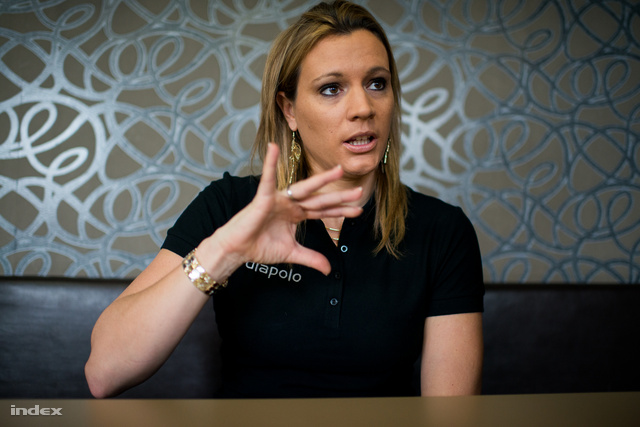 |
Photo: János Bődey / Index
Would you tell me the details?
Now I just laugh at this joke. I never thought then that the case would have a lasting afterlife. But it well described how many other tasks a young athlete has besides swimming. And how constrained they are when they arrive at a competition. I didn't realize at the time exactly what I had to do, so it was a bit surprising and scary that after the burden and the enormous stress had been lifted from me, I won and calmed down, I couldn't walk away and be with myself and the gold medal. I had to tell what and how I had done for that idyllic moment of coming first in the end.
At that time, there was no special zone where journalists could ask athletes questions. And I actually did one or two laps around the diving pool while the reporters ran after me, because I was unprepared, inexperienced, and at that time I didn't really like giving interviews, it was like everyone wanted to question me, which I didn't feel like doing. Moreover, my reaction was also a bit incomprehensible because it was after my 200m victory, and a few days earlier I had cheerfully served the journalists after the 100m. I thought they had already asked me everything, I had told them everything, and I probably ran away because I didn't want them to ask me any more questions.
And it was also strange because by then I was already an Olympic medalist and the swimming team's biggest contender.
But even then I was only 16 years old. The greats, the authors of the previous successes, i.e. Krisztina Egerszegi, Attila Czene or Norbert Rózsa, were no longer there like they were a year ago at the Atlanta Olympics, so as the only gold medalist, all the attention was focused on me, and I was too young to handle all of this, and the burden and pressure on me was enormous. Perhaps it is fateful, and at the same time ironic, that I earned my degree in marketing and communications in America.