She has been to three Olympics, has three degrees, gives motivational trainings and lectures while writing her doctorate, and is a student at the University of California, Berkeley. She is the president of the Budapest 2024 Athletes' Committee and the mother of five-year-old Dominik. Olympic, world and European champion swimmer Ágnes Kovács found fulfillment in her studies after her sports career and does not regret retiring in 2008.
Considering how busy she is, we were able to arrange an appointment surprisingly quickly. Do you manage your time yourself?
It's a difficult balance, but I absolutely manage my schedule, yes. It wasn't easy to create this system. The more busy I got, the more I felt the importance and necessity of prioritizing. There are things that take precedence in all circumstances, for example my little son. You always need to make time for it.
Are there any customs or rituals related to raising children that you won't let anyone else do?
Going to bed, putting them to sleep are like that, yes. It is very important for me to be there with my little son when he falls asleep at night.
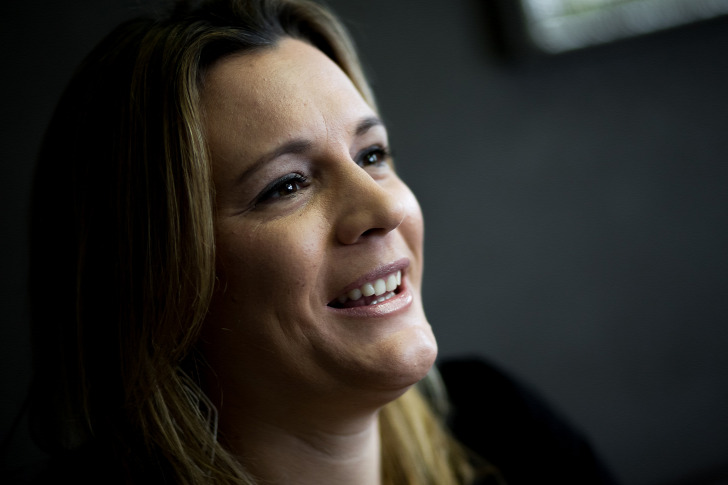 |
"I always have to make time for my little son"
Photo: Adrián Zoltán - Origo
By the way, there are lucky coincidences, for example, my little son is one of the students at my swimming academy, so we go together twice a week after school to the academy. This works very efficiently because I can manage my work while being with him.
And in the meantime, he is also writing his doctorate. How is it going?
I have been a member of the international board at the University of Physical Education since 2009. I started writing my doctorate in 2013. I am progressing with it step by step, but according to the schedule. It was a huge decision on my part to embark on this.
In his dissertation, he writes about the relationship between elite athletes and the media. Why did he choose this topic?
I was part of that very, very interesting era, the communication revolution, which took place during my swimming career. Unconsciously, I became a public figure because of my results. I experienced as closely as possible the emergence of commercial channels alongside public service television, and then celebrity culture. I remember, at the age of 16, at the European Aquatics Championships in Seville, I was the only Hungarian swimmer to win. I came first in the 100 breaststroke, there was a group of journalists there, and although I didn't really like to make statements at the time, I answered their questions.
Two days later came the 200, which I also won, and after the final the reporters were there again. I literally ran away from them because I didn't understand why they were coming again, since I had already told them everything two days ago.
They chased me around the diving pool with microphones in their hands. They shouted for me to stop, so we did a couple of laps, and then I answered their questions. At that time, I lacked any kind of awareness of my relationship with the media, and of course I was a little girl. Since then, I have understood why, I also studied this in America, and I find it very exciting how far it has all developed since then. That is why I chose this topic.
Why was it important for him to have a doctorate?
I am not doing this to be able to say that I have a PhD, but because it is necessary in order to be able to do at the highest level what I chose as my profession in civilian life after my sports career. When I graduated in the United States and came home, I wanted to do a master's degree after my undergraduate degree, so I enrolled at Corvinus University, majoring in economics and sociology, majoring in public opinion research. However, my diploma lacked an intermediate economic language exam, which I did not have the energy for at the time, I could not bring myself to study. Then, when my son was born and I was at home with him for six months, I felt that I needed more intellectually, so I started learning Italian and successfully prepared for the language exam in a year.
It seemed so impossible that I could do this in such a short time that I felt that I was capable of anything. So I applied for the PhD with that momentum. By the way, learning has always been an important part of my life, for example, I did my high school full-time alongside swimming, I was never a private student.
Who did I want to prove to with all this?
It wasn't a desire to prove myself, but rather a sense of duty. When I entered high school, I already knew that this was important to me, because I was aware that a sports career could end at any time, but learning is for the long term. My coaches had a hard time accepting it, but they understood that if I didn't study properly, if I couldn't do well in school, it would take away from my athletic performance, because it would affect my conscience.